Low cholesterol meals are built primarily from plant foods: oats, beans, lentils, vegetables, fruit, nuts and olive oil, with fish or skinless poultry as lean animal protein. The key is keeping saturated fat low: it raises LDL cholesterol more than the cholesterol in food does. In a 2025 randomized crossover study in the American Journal of Clinical Nutrition, a diet with 600 mg of cholesterol a day and little saturated fat (6% of calories) lowered LDL compared with a control diet, while a diet with only 300 mg of cholesterol but more saturated fat (12%) did not. Below are evidence-based breakfast, lunch and dinner ideas, a sample day plan, and cooking methods that support healthy cholesterol levels.
Why Low Cholesterol Meals Target Saturated Fat First
Past dietary guidelines recommended consuming no more than 300 mg of cholesterol per day, or under 200 mg for individuals with heart-disease risk factors. The 2020–2025 US Dietary Guidelines removed that cap and instead advise keeping dietary cholesterol “as low as possible without compromising nutritional adequacy.” This shift followed findings from the 2015 Dietary Guidelines Advisory Committee showing that dietary cholesterol has no appreciable relationship with serum cholesterol for most people.
A 2019 American Heart Association (AHA) science advisory reached a similar conclusion: studies generally have not supported an independent association between dietary cholesterol and cardiovascular risk, largely because cholesterol-rich foods usually co-occur with saturated fat. The AHA emphasized that adhering to healthy overall dietary patterns, such as the Mediterranean or DASH diets, is more effective than focusing on a single numeric cholesterol target.
Dietary cholesterol still affects certain individuals. People with familial hyperlipidemia, type 2 diabetes, or those who are hyper-responders may experience an increase in blood cholesterol with high dietary cholesterol intake.
What to Eat With No Cholesterol
Because cholesterol is produced only by animals, all plant-based foods—fruits, vegetables, grains, legumes, nuts, seeds and vegetable oils—contain 0 mg of dietary cholesterol. Under FDA labeling rules, “cholesterol-free” denotes less than 2 mg per serving, while “low cholesterol” means 20 mg or less. Every whole plant food qualifies as cholesterol-free. Tofu, lentils, chickpeas, black beans and edamame serve as zero-cholesterol protein sources.
Some plant foods and food components can lower LDL cholesterol:
| Food component | Daily amount | Typical LDL effect | Where to find it |
|---|---|---|---|
| Soluble fiber | +5–10 g | About 5% lower | Beans, oats, barley, apples, flax, chia |
| Beta-glucan | 3 g | About 6% lower (meta-analysis of 28 trials) | Oats, barley |
| Psyllium | About 10 g | Roughly 5–10% lower | Psyllium husk |
| Plant sterols/stanols | About 2 g | 5–15% lower, often within weeks | Fortified spreads, yogurt, milk |
| Extra virgin olive oil | At least 1.5 tbsp (20 g) for 6+ weeks | 10% or more (UC Davis report) | Dressings, cooking |
A typical diet supplies only 200–400 mg of plant sterols and stanols per day, an amount insufficient to lower cholesterol. Fortified foods provide 0.75–2 g per serving. In the gut, plant sterols compete with cholesterol and can cut cholesterol absorption by 30–50%.
Low Cholesterol Breakfast Ideas
Breakfast is an easy time to add soluble fiber and beta-glucan. Ideas from the Cleveland Clinic and the Irish Heart Foundation include:
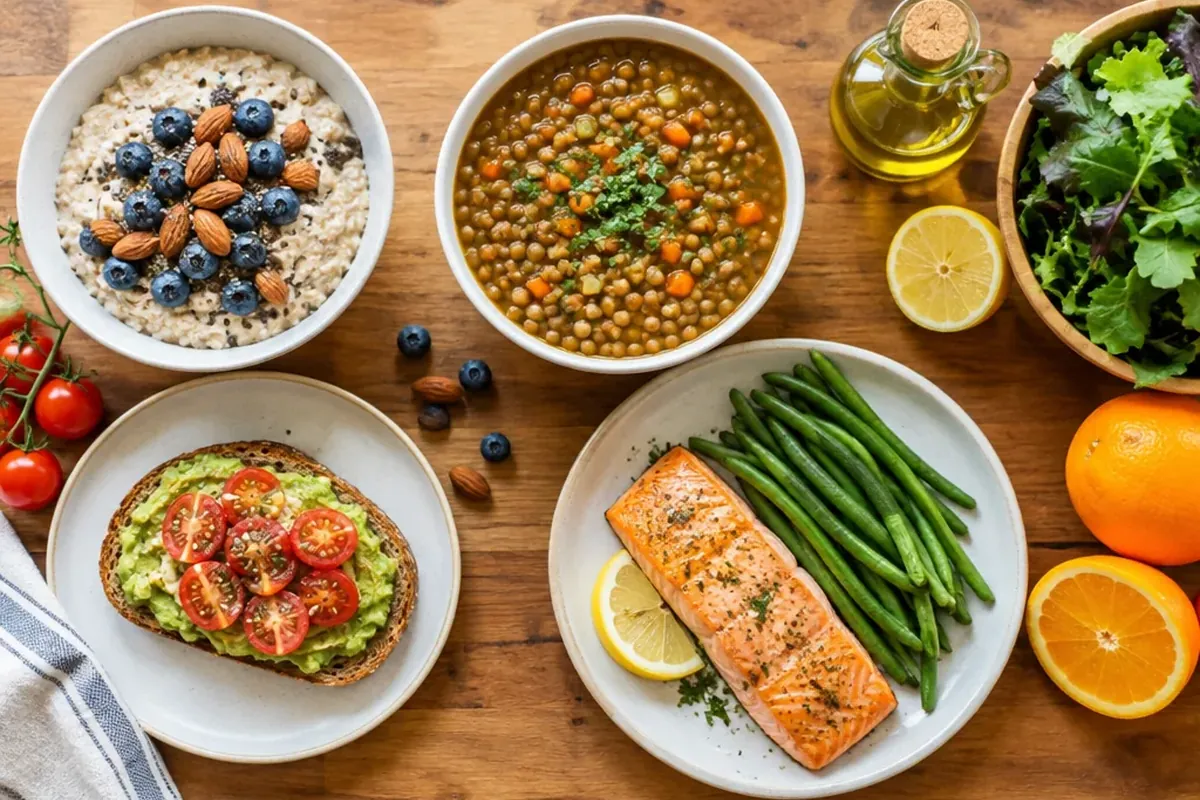
- Oatmeal topped with berries and almonds (a swap for blueberry muffins recommended by Kaiser Permanente).
- Porridge with blueberries, ground flaxseed and walnuts.
- Overnight oats with apple, cinnamon and chia seeds.
- Wholegrain toast with avocado and tomato.
- Yogurt with no added sugar, combined with fruit, oats, nuts and flaxseed, or natural yogurt with low-sugar granola and berries.
- Veggie omelet “muffins” made with egg whites and chopped fresh vegetables.
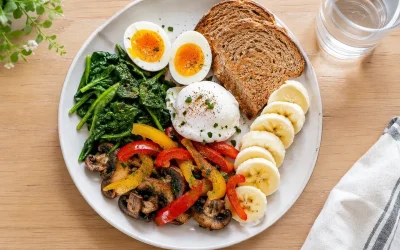
Whole eggs remain an option for healthy individuals: a large egg contains approximately 190 mg of cholesterol—all in the yolk—but only 8% of the daily saturated-fat allowance. According to the AHA, people with healthy cholesterol levels can consume up to one egg per day.
Simple Low Cholesterol Meals for Lunch
Nutritious midday meals combine legumes or lean proteins with whole grains and vegetables:
- Whole-wheat pita with hummus and vegetables
- Lentil soup with a slice of wholegrain bread
- Chickpea salad with an olive oil dressing
- Wholegrain wrap with grilled chicken, leafy greens and hummus
Kaiser Permanente highlights swapping refined white bread for whole wheat with hummus. In addition, half a cup of beans contributes directly toward the 15 g daily soluble-fiber target recommended by Oregon State University (OSU) Extension.
Low Cholesterol Dinners: With Meat, Fish or Vegetarian
Dinner options can include fish, poultry or plant proteins while keeping saturated fat low and fiber high:
- Salmon with green beans: 4 oz salmon served with green beans topped with toasted almonds and mixed salad greens (Mayo Clinic).
- Chicken stir-fry: 3 oz chicken prepared with eggplant and brown rice (Mayo Clinic).
- Turkey chili with kidney beans: lean poultry paired with fiber-rich legumes (Mayo Clinic).
- Baked garlic and herb salmon with mixed vegetables (Irish Heart Foundation).
Kaiser Permanente recommends replacing red meat twice a week with fish, such as salmon, trout, sardines or mackerel. Vegetarian options centered on black beans, lentils, chickpeas, or tofu and edamame provide protein with zero dietary cholesterol.
A Sample Day of Low Cholesterol Eating
Mayo Clinic’s Day 1 heart-healthy menu demonstrates how a complete day of low-cholesterol meals is structured:
| Meal | What’s on the plate |
|---|---|
| Breakfast | 1 cup oatmeal with 1 tbsp walnuts, 1 banana, 1 cup skim milk |
| Lunch | 1 cup low-fat yogurt with 1 tsp flaxseed, 1 cup peach halves, 5 Melba toast crackers, raw broccoli and cauliflower |
| Dinner | 4 oz salmon, ½ cup green beans with toasted almonds, 2 cups mixed salad greens, 1 small orange |
| Snack | ¼ cup raisins, 20 dark chocolate chips, 1 cup skim milk |
| Daily total | 1,688 kcal, 29 g fiber, 126 mg cholesterol |
Mayo Clinic’s Day 2 plan provides 1,621 kcal and 31 g of fat. Breakfast is low-fat yogurt with ¾ cup blueberries and calcium-fortified orange juice. Lunch is a whole-wheat pita with romaine, tomato, cucumber, feta and reduced-fat ranch, plus a kiwi and skim milk. Dinner is a chicken stir-fry (3 oz) with eggplant and brown rice with dried apricots. The snack is 2 tbsp unsalted mixed nuts and fat-free frozen yogurt.
Low Cholesterol Meals for Families: Shopping and Cooking
Shop with the 5-4-3-2-1 rule
Kaiser Permanente’s 5-4-3-2-1 rule balances grocery shopping by selecting: 5 types of vegetables, 4 types of fruit, 3 whole-grain carbohydrate sources, 2 lean protein sources and 1 healthy fat source per trip.
- Produce: leafy greens, berries, avocados, citrus, sweet potatoes
- Grains: steel-cut oats, barley, quinoa, whole-wheat pasta
- Proteins: salmon, tuna, skinless poultry, tofu, legumes
- Fats: olive oil, avocado oil, flaxseeds, chia seeds
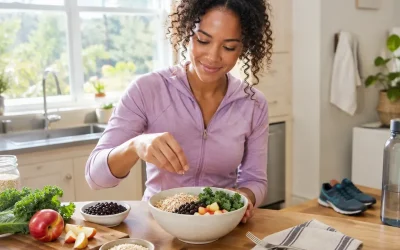
To reach OSU Extension’s target of 15 g of soluble fiber daily, combine everyday portions such as ½ cup beans, 2 tbsp flax or chia seeds, ½ cup oats or barley, and one apple, apricot or fig.
Cook to cut saturated fat
The healthiest cooking methods avoid added saturated fat: baking, broiling, grilling, poaching, steaming, stir-frying with minimal oil, and roasting on a rack. Steaming preserves nutrients without added oil and is well suited for vegetables (broccoli, carrots, asparagus, cauliflower) and fish. The AHA recommends:
- Broiling meats instead of pan-frying, and roasting on a rack to allow fat to drain.
- Basting with wine, fruit juices, or oil-based marinades instead of meat drippings.
- Preparing stews, boiled meats, and soup stocks a day in advance, refrigerating them, and removing the hardened surface fat before reheating.
When you eat out
Look for menu terms indicating lighter preparation: “baked,” “broiled,” “grilled,” “poached,” “roasted” and “steamed.” Avoid terms that signal high saturated fat and cholesterol, such as “fried,” “pan-fried,” “creamed,” “breaded,” “au gratin,” “buttered” and “in gravy.” Ask for dressings and sauces on the side, request preparation with minimal or no salt, and substitute steamed vegetables or a side salad for fries. Portions can be managed by ordering a half portion, sharing an entree, or boxing up half the dish immediately. Look for the AHA Heart-Check mark where available. Mediterranean dishes, Chinese steamed preparations, and Indian tandoori dishes generally provide more cholesterol-friendly options than cuisines relying heavily on cheese, cream sauces, and fatty meats.
Common Myths About Low Cholesterol Eating
Myth: Cutting dietary cholesterol is the primary goal. Saturated fat is the main driver of high LDL cholesterol. In the 2025 trial, a diet higher in cholesterol but low in saturated fat lowered LDL, while a low-cholesterol diet with more saturated fat did not.
Myth: All fats raise cholesterol. In a randomized trial comparing butter, coconut oil and olive oil, butter raised LDL significantly more than either oil. A network meta-analysis also found that an olive-oil-based Mediterranean diet significantly reduced total cholesterol and LDL compared to a Western diet.
Myth: Any olive oil works the same. Polyphenol content influences results. In a three-week crossover trial, extra virgin olive oil with total phenol content above 300 mg/kg produced significantly greater LDL reductions than refined olive oil with negligible phenols.
Myth: Blueberries are a cholesterol cure. In a six-month randomized trial of 115 adults with metabolic syndrome, 1 cup of blueberries daily improved HDL cholesterol, endothelial function, and arterial stiffness, but did not significantly lower LDL. A 2021 meta-analysis of 18 clinical studies found modest reductions in total and LDL cholesterol, so blueberries are a helpful part of a diet, not a cure.
Frequently Asked Questions
How much cholesterol is too much?
The 2020–2025 US Dietary Guidelines do not specify a numeric upper limit, advising instead to keep dietary cholesterol intake as low as possible without compromising nutritional adequacy. Previous guidance recommended under 300 mg daily, or under 200 mg for those at elevated cardiovascular risk. People with familial hyperlipidemia or type 2 diabetes, and so-called hyper-responders, may still see their blood cholesterol rise with a high intake. If that applies to you, ask your doctor or a dietitian what limit fits your situation.
Is olive oil good for cholesterol?
Yes. A UC Davis report noted that consuming at least 1.5 tablespoons (20 g) of extra virgin olive oil daily for a minimum of six weeks can decrease LDL by 10% or more. Additionally, a 2024 meta-analysis found that daily consumption of high-polyphenol olive oil (268–600 mg/kg) produced a significant LDL reduction of −4.28 mg/dL.
Why do they say to quit eating blueberries?
In 2024, Harvard updated its oxalate database, listing ½ cup of blueberries at 18.5 mg of oxalate. On a standard low-oxalate diet (under 100 mg daily for kidney stone prevention), this portion represents roughly 19% of the daily allowance. For individuals not managing kidney stones, oxalates in blueberries are not a health concern, and moderate consumption provides beneficial fiber and polyphenols.
What flushes cholesterol out of your body?
No food flushes cholesterol out quickly, but soluble fiber helps the body remove it. It binds cholesterol and bile acids in the intestine, so more of them leave the body in stool. Normally the body recycles about 95% of its bile salts; viscous soluble fiber raises bile acid excretion by 35–65%, so the liver has to use cholesterol from the blood to make new bile acids.
Can blueberries lower cholesterol?
Only modestly. A meta-analysis found small reductions in total and LDL cholesterol in adults with metabolic syndrome, while a six-month trial with 1 cup a day improved HDL and blood vessel function but did not significantly lower LDL. Blueberries add polyphenols and fiber to an overall heart-healthy diet.