One large egg contains about 186 mg of cholesterol, and all of it sits in the yolk. The white has none. That number once made eggs a symbol of heart trouble. Today, the American Heart Association says dietary cholesterol is “no longer a primary target” for lowering cardiovascular risk for most people. The reason for that change, and the groups who should still count their yolks, matters more than the 186 mg figure itself.
How Much Cholesterol Is in an Egg? The Numbers by Size and Part
The standard reference is a large egg weighing 50 g. Most of its fat, and all of its cholesterol, sits in the yolk. Cooking hardly changes the number. Raw whole egg has 372 mg of cholesterol per 100 g, and hard-boiled egg has 373 mg per 100 g.
| Portion | Calories | Protein | Fat | Cholesterol |
|---|---|---|---|---|
| Egg white (from 1 large egg) | 17 kcal | 3.6 g | 0 g | 0 mg |
| Egg yolk (from 1 large egg) | 55 kcal | 2.7 g | 5.3 g | 186 mg |
| Large whole egg, hard-boiled (50 g) | 77.5 kcal | 6.3 g | 5.3 g (1.64 g saturated) | 186 mg |
| Jumbo whole egg (~63 g) | — | — | — | ~234 mg |
The size of the egg changes the count. A jumbo egg has about 26% more cholesterol than a large one. The 186 mg figure holds for raw, boiled, and poached eggs. Frying in butter or oil adds fat but doesn’t change the cholesterol already in the egg.
Egg Yolk vs. Egg White: Which Is Better for Cholesterol?
So how much cholesterol is in an egg white? Zero. Egg white is also a complete protein, with the top PDCAAS score of 1.0. The yolk, though, holds nearly all of the egg’s other nutrients: the fat-soluble vitamins A, D, E, and K, plus choline, lutein, zeaxanthin, and most of the selenium and B12. A whole large egg provides:
- 147 mg choline (27% of the Daily Value for women, 23% for men)
- 0.6 µg vitamin B12 (25% DV)
- 15.4 µg selenium (28% DV)
- About 190 µg lutein plus zeaxanthin, carotenoids linked to eye health
Skipping the yolk removes the cholesterol, but it also removes most of the micronutrients. Trials show both sides of this trade-off:
- In a 6-week trial of 40 adults with high blood lipids, a yolk-free egg substitute lowered total cholesterol by 18 mg/dL and LDL-C by 14 mg/dL more than whole eggs did. It also improved blood vessel function.
- A meta-analysis of 8 randomized trials found that eating more than 4 whole eggs a week raised LDL-C by 6.6 mg/dL more than the same amount of substitute. It also raised HDL-C by 2.6 mg/dL more.
- With whole eggs, blood lutein rose 21% and zeaxanthin 48%. With the substitute, neither rose.
Why the 300 mg Daily Limit Disappeared
For about 50 years, US advice capped dietary cholesterol at 300 mg a day, which is less than two large eggs. Here is how that rule came and went:
- 1968: The American Heart Association recommended less than 300 mg of cholesterol a day and no more than 3 eggs a week.
- 1977: The Dietary Goals for the United States adopted the 300 mg limit, and it stayed in US guidance for decades.
- 2005: The Dietary Guidelines for Americans put the under-300 mg limit in writing as a number for the first time. The reasoning was a “direct and progressive” link between dietary cholesterol and LDL.
- 2015–2020: The guidelines dropped the cap and stated there was “no appreciable relationship” between dietary cholesterol and blood cholesterol.
- 2020–2025: The guidelines still have no number for cholesterol and focus on overall eating patterns instead.
- 2023, UK: The National Institute for Health and Care Excellence (NICE) removed its 300 mg daily recommendation, noting “no evidence to support a limit” and that saturated fat has a greater impact on cholesterol profile.
Egg Cholesterol, LDL or HDL: The Truth About Eggs and Cholesterol
For most people, your liver makes less cholesterol of its own when more arrives from food. That is the main reason egg cholesterol doesn’t simply add to your blood cholesterol. The evidence varies in strength, so it helps to sort it.
Strongest evidence: randomized trials
A 2025 crossover trial in 61 adults had each person follow several diets for 5 weeks at a time. It found that saturated fat, not dietary cholesterol, pushed LDL-C up. A diet with 2 eggs a day and low saturated fat (6% of calories) actually lowered LDL-C compared with a control diet high in saturated fat. A related 2025 analysis by the same group came to the same conclusion. Saturated fat intake tracked with LDL-C, and dietary cholesterol did not.
Moderate evidence: large observational studies
In the Framingham Offspring Study (1,852 participants), eating 5 or more eggs a week was not linked to worse lipid levels. In men, it was linked to 8.6 mg/dL lower total cholesterol and 5.9 mg/dL lower LDL-C. People who ate eggs along with plenty of fiber had the lowest LDL-C and the best LDL/HDL ratio. A 2025 umbrella review of 14 meta-analyses rated the evidence tying eggs to harm as critically low in strength. Its conclusion: there isn’t enough evidence to discourage eating eggs.
Evidence pointing the other way
Not every study clears eggs. A PLOS Medicine analysis of 521,120 people linked whole eggs and dietary cholesterol to higher death rates from all causes, heart disease, and cancer. It attributed 63% of the egg link to cholesterol content. A Chinese cohort of 33,025 adults found that eating 6 or more eggs a week went along with slightly higher LDL-C, by 1.8 mg/dL. Both are observational studies. They show associations, not cause and effect.
Why your response may differ
- About 30% of people are “hyperabsorbers” or hyper-responders who absorb more dietary cholesterol because of their genes. In this group, 3 eggs a day raised both LDL and HDL, while the LDL/HDL ratio stayed the same.
- People who carry the APOE4 gene variant are more sensitive. An extra 300 mg of cholesterol a day can raise their total cholesterol by about 10%.
- In both responder types, eating eggs increased large HDL particles by 12%, blood lutein by 17%, zeaxanthin by 30%, and choline by 12%.
Is Eating Eggs Every Day Bad for Cholesterol? Limits by Health Status
Health organizations broadly agree that healthy adults can eat eggs regularly. They draw the line for people who already have heart disease, high cholesterol, or diabetes.
| Source | Healthy adults | Heart disease, high cholesterol, or diabetes |
|---|---|---|
| American Heart Association | Eggs in moderation within a heart-healthy pattern | About 4 yolks per week |
| AHA science advisory (2019) | Older adults with normal cholesterol: up to 2 eggs/day | Be cautious with cholesterol-rich foods (also applies if you’re at risk for heart failure) |
| Mayo Clinic | Up to 7 eggs/week without added heart risk | Caution if you have diabetes |
| Mass General Brigham | — | About 1 egg/day averaged over a week; switch to whites if concerned |
| Heart Foundation Australia | — | No more than 7 eggs/week |
Cedars-Sinai puts it plainly: one egg a day is unlikely to raise your cholesterol or heart risk by much, as long as you keep the saturated fat in the rest of your diet low.
What about 6 eggs a day?
That is far above every guideline listed here. In a 1985 study run in a controlled metabolic ward, 6 egg yolks a day for 10 days raised total cholesterol by 13% and LDL-C by 21%. Some HDL subtypes rose too. No current guideline supports eating that much every day.
Does a Boiled Egg Increase Cholesterol? Cooking Methods and What’s on Your Plate
A boiled egg has the same 186 mg of cholesterol as a raw one, and boiling adds no fat. Cooking does change other things:
- Added fat: 1 teaspoon of butter adds about 35 calories and 4 g of fat, much of it saturated. 1 teaspoon of oil adds about 40 calories and 4.5 g of fat.
- Oxidation: High heat, especially pan-frying, oxidizes some of the yolk’s cholesterol into oxysterols. These compounds may promote inflammation, though the evidence here is limited.
- Nutrient loss: Baking eggs for 40 minutes can destroy up to 61% of their vitamin D. Shorter frying or boiling causes losses of up to 18%.
What you eat alongside the eggs often matters more than the eggs themselves. Bacon, sausage, buttered toast, and hash browns add more saturated fat and refined carbs than the eggs do. In the Framingham data, people who ate eggs along with more fish had a 39% lower risk of high LDL-C (HR 0.61). Those who ate eggs with more fiber had a 30% lower risk (HR 0.70).
The Best Way to Eat Eggs if You Have High Cholesterol
- Poach or boil. These methods add no fat and use lower heat, which helps preserve nutrients.
- Mix 1 whole egg with 2 whites. You keep the yolk’s nutrients and cut cholesterol by about two-thirds.
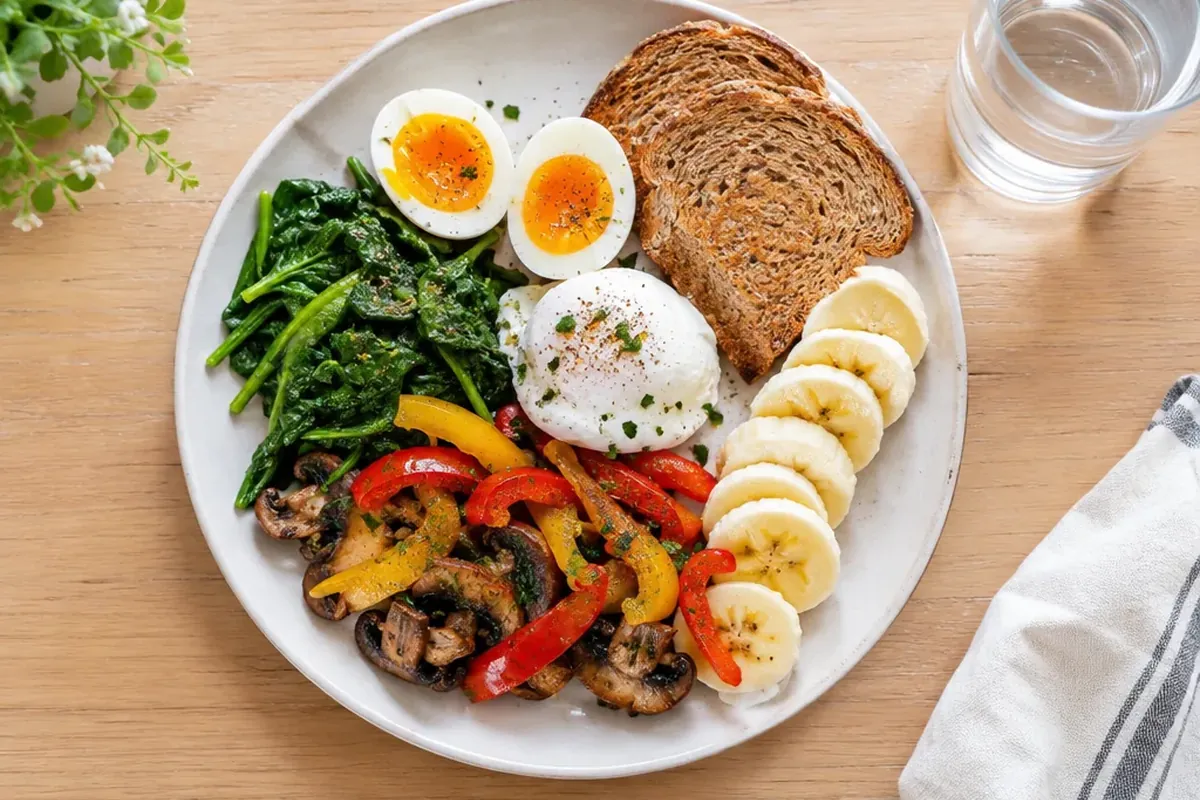
- Add vegetables and whole grains. Spinach, peppers, mushrooms, onions, oats, or whole-wheat toast add fiber, which helps offset any rise in LDL.
- Use the right fat if you fry. Choose a little olive or avocado oil, or cooking spray, instead of butter or coconut oil.
- Skip the saturated-fat extras. Leave out bacon, sausage, full-fat cheese, butter, and hollandaise sauce.
- Count your yolks for the week. If you have heart disease or diabetes, aim for about 4 yolks a week and use whites for the rest.
- Consider pasture-raised or organic eggs. They may have a better fatty acid profile and more carotenoids.
Common Myths About Eggs and Cholesterol
- Myth: The cholesterol you eat becomes cholesterol in your blood. For most people, the liver makes less of its own to compensate. Saturated fat has a much larger effect on LDL.
- Myth: Boiling or frying changes an egg’s cholesterol. Raw and hard-boiled eggs have practically identical amounts (372 vs. 373 mg per 100 g). Frying changes the fat content, not the cholesterol.
- Myth: Egg whites are always the better choice. Whites have no cholesterol, but whole eggs raise HDL more and provide lutein, zeaxanthin, and choline that whites don’t.
- Myth: Eggs are off-limits for everyone with high cholesterol. Major heart organizations still allow about 4 to 7 eggs a week for people at higher risk.
- Myth: The old 3-eggs-a-week rule is still official advice. That number comes from 1968. US guidelines dropped the numeric cholesterol limit in 2015.
Beyond Eggs: What Lowers Cholesterol and What Raises It Most
If your LDL is high, the foods that raise it most are those rich in saturated fat. These include red meat (beef, pork, lamb), processed meats (sausage, bacon, salami), full-fat dairy (cream, butter, whole milk, cheese), and tropical oils such as palm and coconut oil. Trans fats from fried foods, packaged baked goods, and hydrogenated oils raise LDL and consistently increase heart disease risk. The AHA advises keeping saturated fat under 7% of daily calories, while general US guidelines say under 10%. On a 2,000-calorie diet, that works out to roughly 13 to 22 g a day. For comparison, one egg contains about 1.6 g.
The dietary changes with the most evidence behind them for lowering LDL:
- Soluble fiber: 5–10 g a day lowers LDL-C by about 8–9 mg/dL. Each additional 5 g brings roughly 5.6 mg/dL more.
- Plant sterols and stanols: 2 g a day can lower LDL by 5–15%, often within weeks.
- The Portfolio diet: Combining 2 g of plant sterols, 10–20 g of viscous fiber, 50 g of plant protein, and 45 g of nuts a day lowers LDL-C by 13–30%. That is comparable to first-generation statins.
- Fat swaps: Replacing saturated fat with unsaturated fat lowers cardiovascular risk by about 30%, according to an AHA analysis of the highest-quality trials.
Frequently Asked Questions
Are eggs bad for high cholesterol?
Not necessarily. Most heart organizations allow about 4 to 7 eggs a week if you have high cholesterol. In a 2025 trial, 2 eggs a day as part of a low-saturated-fat diet lowered LDL-C compared with a diet high in saturated fat. If you have high LDL, heart disease, or diabetes, ask your doctor or a dietitian how many eggs fit your plan.
Is 6 eggs a day bad for cholesterol?
Six eggs a day is well above every current recommendation. In a short metabolic study, 6 yolks a day raised LDL-C by 21% within 10 days. Even generous guidance for healthy older adults stops at 2 eggs a day.
Are bananas good for cholesterol?
They can help. A medium banana has about 3 g of fiber, including pectin, which binds bile acids so the body gets rid of more cholesterol. It also provides 422 mg of potassium. In a small study of 30 healthy men, eating 2 ripe bananas a day for 4 weeks lowered total cholesterol and triglycerides. Greener bananas contain more resistant starch and pectin.
What reduces cholesterol quickly?
Plant sterols and stanols (2 g a day) can lower LDL by 5–15% within weeks. Adding soluble fiber and cutting saturated fat also help. Combining all of these, as the Portfolio diet does, can lower LDL by up to 30%.
What are the worst foods for high cholesterol?
The biggest problems are foods high in saturated or trans fat: red and processed meats, butter, cream, cheese, palm and coconut oil, fried foods, and packaged baked goods.